Made in USA Research Peptides: Why Origin and Batch Testing Matter in 2026
Your peptide vial says "Made in USA," but the label tells you nothing about who tested it. Origin claims and batch-level purity data are what separate a documented research material from an anonymous powder.
This article explains why origin and per-batch testing matter for research peptides in 2026, how Kovagen documents its US manufacturing and independent lab analysis, and how to read a 7-panel COA and retrieve it by batch number so you can judge a supplier before you order.
What Is Kovagen (KOVA)?
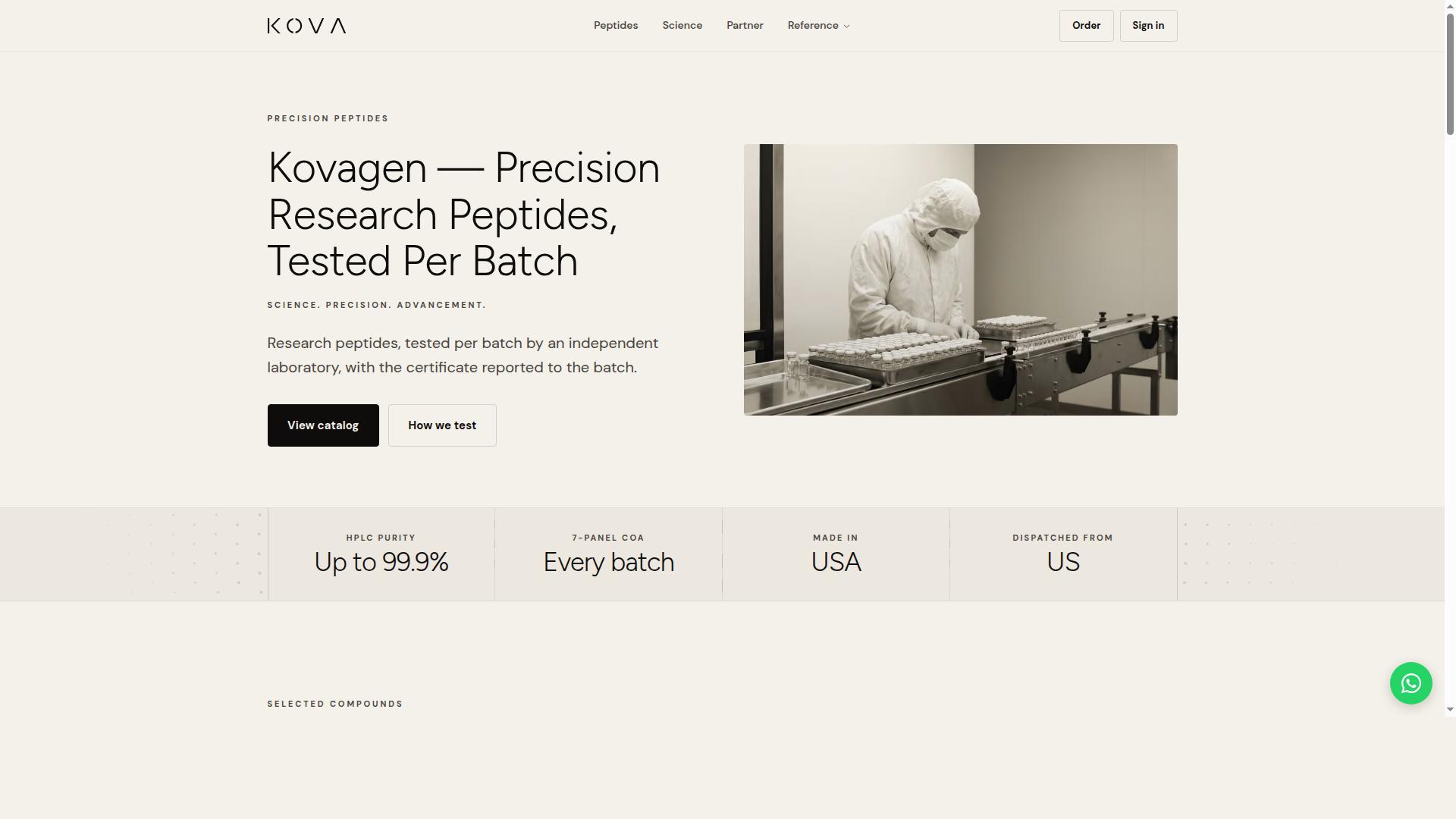
Kovagen (KOVA) is a research peptide supplier that ships to the United States and Canada, offering lyophilized peptides and research supplies tested per batch by an independent laboratory. KOVA is the mark printed on the vial and a trading name of Kovagen, so both names point to the same catalog and certificate library.
The brand supplies research peptides as lyophilized powder, including single compounds and blends, plus supporting research supplies. Every batch is tested by an independent analytical laboratory, and certificates of analysis are published per batch.
Who Kovagen Serves and What It Supplies
Kovagen serves laboratory researchers who require research peptides and supplies strictly for laboratory research use, not for human or veterinary consumption. This is the audience the entire catalog is built around, and the research-use-only disclaimer applies to every product Kovagen ships.
The product range covers stocked research peptides as lyophilized powder, including single compounds and blends, alongside research supplies. The catalog lists 30 compounds: 22 single peptides and blends, giving researchers a defined set to work from rather than an open-ended listing.
Named compounds in the catalog include Retatrutide (GLP-3), BPC-157, GHK-Cu, Wolverine (BPC-157 / TB-500), and TB-500 Thymosin Beta-4. These are supplied as research materials only, and each is tied to the batch-level testing and certificate of analysis documentation described above.
The research-use-only disclaimer is not incidental. It frames how Kovagen presents its catalog and why batch testing and published certificates of analysis matter to the researchers it serves. For a laboratory buyer, documented testing is part of evaluating a supplier, and Kovagen makes that documentation available per batch.
Why Origin and Batch Testing Matter for Made in USA Research Peptides in 2026
In 2026, researchers evaluating made-in-USA research peptides should prioritize country of origin and batch testing because these factors directly affect reproducibility and supply chain transparency. A domestic label tells you where a product was finished, not whether it meets the standards your work depends on.
The two questions are linked. Origin shapes the logistics and regulatory environment behind a product, while batch testing proves what is actually inside a given vial. Treating either one as a marketing claim rather than a verifiable fact invites inconsistency into experiments that are hard enough to control already.
Domestic manufacturing simplifies logistics but does not guarantee quality. Shorter shipping routes and clearer jurisdiction can reduce handling risk, yet neither replaces analytical evidence. A peptide can be synthesized in the United States and still fall short on purity, sterility, or documentation. Researchers should separate the convenience of a domestic supply chain from the proof of what the material contains.
Independent verification closes that gap. When a supplier commissions a third-party laboratory analysis for each lot, the resulting data stands apart from internal quality claims. That distinction matters because self-reported specifications are only as reliable as the process behind them.
Batch testing gives researchers objective data on three fronts: identity, purity, and contaminants. Each front maps to specific analytical methods that a qualified laboratory should be able to document.
- Identity and sequence: Mass spectrometry supports peptide sequence confirmation, verifying that the molecule matches its stated structure.
- Purity: High-performance liquid chromatography (HPLC purity testing) quantifies how much of the sample is the target peptide versus related impurities.
- Contaminants: Sterility testing and endotoxin screening address microbial risk, while heavy metal analysis and residual solvents testing cover chemical residues.
A certificate of analysis should tie these results to a specific batch number, not to a product line in general. Batch-level COAs enable traceability: if a result looks unusual, the researcher can trace the lot, the test date, and the laboratory that produced the data. Generic or undated certificates undercut that chain.
COA verification is a practical skill. Researchers should confirm that the document names the testing laboratory, lists the methods used, and reports actual measured values rather than pass or fail labels alone. ISO 17025 accreditation at the analytical testing laboratory adds confidence that methods were validated and results are defensible.
Good manufacturing practices and GMP compliance describe the controls around production, including raw material sourcing and API synthesis. These frameworks support consistency, but they are process claims. Independent testing is what converts a process claim into observable evidence about a specific vial.
In practice, a researcher assessing any supplier can apply a short checklist before ordering:
- Ask whether the country of origin claim is documented, not just stated on a label.
- Request a batch-specific COA and check that the batch number matches the product received.
- Confirm which analytical methods were used and whether the laboratory is independent.
- Look for testing that covers identity, purity, sterility, endotoxins, heavy metals, and residual solvents.
Supply chain transparency is the thread connecting all of these steps. A supplier that can explain where raw materials originate, how synthesis is controlled, and which laboratory tested each lot gives researchers something to verify. That verifiability, more than any single claim, is what supports reproducible work in 2026.
How Kovagen Answers the Origin Question: Made in USA, Dispatched from the US
Kovagen addresses the origin question by supplying research peptides tested per batch by an independent laboratory and dispatching every U.S. order via FedEx 2Day from within the United States. This is a clear, checkable answer to a question that matters more than ever in 2026: where does the product come from, and who verified it?
For researchers evaluating country of origin and supply chain transparency, Kovagen's position is straightforward. The brand does not claim domestic peptide manufacturing in its published details. Instead, it leans on two pillars that researchers can actually assess: per-batch independent testing and U.S. dispatch.
Kovagen ships to the United States and Canada only. It cannot ship anywhere else at this time. That narrow service area is worth noting because it keeps the fulfillment path short and predictable for North American buyers.
Every U.S. order goes out via FedEx 2Day, and dispatch happens by the next business day. Researchers know when their material leaves and roughly when it arrives, which supports planning around lab schedules and storage readiness.
Batch testing is the heart of Kovagen's quality story. Each batch is tested by an independent laboratory, which means the analysis is separated from the party selling the product. That separation is what makes independent verification meaningful.
In the broader research peptide market, reputable testing typically covers several fronts. Buyers should understand what each test tells them:
- High-performance liquid chromatography (HPLC purity testing) estimates how much of the sample is the target compound.
- Mass spectrometry and peptide sequence confirmation check that the molecule matches its expected identity.
- Sterility testing and endotoxin screening flag microbial contamination risks.
- Heavy metal analysis and residual solvents testing screen for process-related impurities.
When these results are documented in a certificate of analysis, researchers can perform COA verification against the batch in hand. Testing tied to a specific batch, rather than a generic report, is what makes that verification possible.
Origin and testing work best as a pair. U.S. dispatch shortens transit and reduces the handling a shipment goes through. Per-batch testing gives the researcher a documented record of what was analyzed. Together, they create a trail that supports supply chain transparency from dispatch to bench.
It is important to be precise about what Kovagen states and what it does not. The brand does not claim domestic peptide manufacturing, GMP compliance, or ISO 17025 accreditation in its published details. Researchers who need those specifics should confirm them directly rather than assume them.
What Kovagen does provide is concrete and verifiable in practice: batch-level independent analysis, U.S. shipping via FedEx 2Day with next-business-day dispatch, and service limited to the United States and Canada. For researchers weighing Made in USA research peptides, that is a transparent, defensible answer to the origin question.
Batch Testing at Kovagen: Independent Labs and Per-Batch Certificates
Kovagen tests every batch through an independent analytical laboratory and publishes a certificate of analysis for each batch, retrievable by batch number without an account. That single design choice separates verifiable quality control from marketing claims, because the people generating the data are not the people selling the product.
In-house testing creates an obvious conflict of interest. When the same facility synthesizes a peptide and signs off on its purity, a researcher has no way to confirm that the numbers reflect reality. Third-party laboratory analysis removes that conflict by placing the measurement in neutral hands.
Kovagen's approach fits the broader shift toward supply chain transparency in the research peptide market. Country of origin matters, and domestic peptide manufacturing under good manufacturing practices provides a baseline. But origin alone does not prove that a specific vial contains what its label says. Batch-level evidence does.
The practical benefit is independent verification. A researcher can pull the certificate for the exact lot in hand, compare it against the vial, and decide whether the material meets the study's requirements before any work begins. That is a meaningfully different standard from a single certificate reused across months of inventory.
Kovagen also states that it does not publish customer reviews or provide dosing, administration, or reconstitution guidance. The documentation strategy therefore rests on analytical records rather than testimonials, which suits a research audience that values data over anecdote.
Reading a 7-Panel COA and Retrieving It by Batch Number
A 7-panel certificate of analysis typically reports HPLC purity, mass spectrometry identity confirmation, peptide sequence verification, sterility, endotoxin levels, heavy metals, and residual solvents. Each panel answers a different question, and reading them together gives a fuller picture than any single number.
High-performance liquid chromatography reports the percentage of the target peptide in the sample. Kovagen lists HPLC purity up to 99.9%, and the chromatogram should show the main peak alongside any impurity peaks so the figure can be checked rather than simply trusted.
Mass spectrometry confirms molecular weight, catching cases where the correct compound name appears on a label but a different molecule sits in the vial. Peptide sequence confirmation goes a step further, verifying the amino acid order itself.
The remaining panels address safety and process residue:
- Sterility testing checks for microbial contamination
- Endotoxin screening measures bacterial endotoxin levels
- Heavy metal analysis looks for elemental impurities
- Residual solvents detect chemicals left over from synthesis and purification
Retrieval is straightforward. A researcher enters the batch number on Kovagen's site and the matching certificate appears, with no account required. That matters because gated documentation slows verification and discourages the very checks a careful buyer should perform.
Before use, match the batch number printed on the vial to the number on the certificate. Then review each panel against the acceptance criteria relevant to the study, rather than scanning only the purity headline. A certificate is most useful when it is read panel by panel and tied to the exact lot in hand.
Key Features and What Makes Kovagen Stand Out
Kovagen differentiates itself through independent per-batch laboratory testing, publicly retrievable certificates of analysis, and HPLC purity up to 99.9%. For researchers weighing country of origin and batch testing in 2026, those three points answer most of the questions that matter before an order is placed.
The model is simple to describe and hard to fake. Every batch is sent to an independent analytical testing laboratory, and the resulting certificate is tied to that specific batch. Buyers are not asked to trust a single lab report posted once and left to cover years of production.
Four features define how Kovagen approaches supply chain transparency and independent verification:
- Per-batch testing by an independent laboratory. Each batch, not each product line, goes through third-party laboratory analysis before release.
- COAs retrievable by batch number, no account required. Anyone holding a batch number can pull the matching certificate directly. No login wall, no email request, no waiting on support.
- HPLC purity up to 99.9%. High-performance liquid chromatography is the standard method for measuring peptide purity, and Kovagen reports results up to that ceiling.
- A catalog of 30 compounds. This includes 22 single peptides plus blends, covering common research categories rather than a single narrow line.
The no-account COA lookup deserves emphasis. COA verification only works as a transparency tool when it is fast and unconditional. A certificate that requires an account, a support ticket, or a sales conversation is a certificate most researchers will never check. Kovagen removes those steps entirely.
Purity reporting is equally direct. HPLC purity testing is the most widely understood measure of peptide quality, and a stated ceiling of up to 99.9% gives buyers a concrete benchmark to compare against the certificate in hand. The number and the document should agree, and that is the point.
The 30-compound catalog, split into 22 single peptides and blends, keeps the range practical without stretching testing capacity. A focused catalog is easier to test batch by batch than a sprawling one. Kovagen ships to the United States and Canada.
Kovagen also runs a partner program with straightforward terms. Partners earn 25% on each referred new customer's first eligible order. After that, they earn 10% on eligible repeat orders for life. The structure rewards referrals that turn into ongoing research relationships rather than one-off transactions.
Taken together, the features point in one direction. Independent per-batch testing, open COA retrieval, documented HPLC purity, and a defined catalog give researchers the documentation trail they need to evaluate a supplier on evidence rather than claims. That is what origin and batch testing are supposed to deliver in 2026.
Pricing and Plans
Kovagen lists prices in USD, with examples including Retatrutide (GLP-3) from $95.00, BPC-157 10mg at $80.00, GHK-Cu from $55.00, Wolverine (BPC-157 / TB-500) 10/10 at $140.00, and TB-500 Thymosin Beta-4 (Long Chain) 10mg at $85.00. All figures are quoted in US dollars, so researchers comparing budgets can plan without currency conversion guesswork.
Pricing spans a wide range of compounds, from single-vial basics to multi-peptide blends. A few more examples show how the catalog scales:
- Klow (GHK-Cu / TB-500 / BPC-157 / KPV) 50/10/10/10 at $175.00
- Regeno (Cartalax / BPC-157 / TB-500) 10/10/10 at $285.00
- Metabolic (NAD+ / MOTS-c / 5 Amino 1MQ) 100/10/10 at $185.00
- Tesamorelin 10mg at $110.00 and MOTS-c 20mg at $160.00
- BAC Water single vial at $15.00
Smaller single compounds sit at the lower end, including Melanotan II 10mg at $50.00, Semax 10mg at $60.00, and Ipamorelin 10mg at $75.00. Mid-range options include CJC-1295 No DAC / Ipamorelin 5/5 at $85.00 and Thymosin Alpha-1 10mg at $135.00. Every listed price is stated in USD and reflects the product as described, with no hidden tier structure.
Shipping is straightforward. Kovagen dispatches every U.S. order via FedEx 2Day, with orders sent out by the next business day. Shipping is free on orders of $250 or more after discounts. Below that threshold, the shipping charge is $18.
Kovagen also runs a partner program built on referral rewards. Partners earn 25% on each referred new customer's first eligible order. After that, they earn 10% on that customer's eligible repeat orders for life. The structure rewards long-term relationships rather than one-off transactions, which fits a research supply category where buyers often reorder the same compounds.
For buyers weighing cost against origin and batch testing, the pricing picture is clear: a defined USD catalog, a single transparent shipping rate, and a partner program with published percentages. No additional plans or discount tiers are listed beyond these details.
Trust Signals: What Kovagen's Testing and Shipping Practices Demonstrate
Kovagen's trust signals include independent per-batch laboratory testing, publicly accessible certificates of analysis, and consistent FedEx 2Day shipping for U.S. orders. Each of these choices is a deliberate design decision, not a marketing afterthought. Together they shift the burden of proof from the buyer's assumptions to documents anyone can check.
The logic behind independent verification is straightforward. A supplier can claim purity in product copy, but a third-party laboratory analysis performed by a lab that has no stake in the sale is evidence of a different order. When that evidence is published per batch, a researcher can confirm what was actually tested rather than what was promised.
Why Published COAs Matter More Than Marketing Claims
A certificate of analysis is only useful if it can be matched to the specific batch in hand. Kovagen addresses this by making COAs retrievable by batch number without requiring an account. That detail matters, because COA verification should not depend on a login, a sales conversation, or a request form that may never be answered.
For a researcher, the practical benefit is a short, repeatable check. The batch number on the label points to a document that lists what the analytical testing laboratory measured, so the record can be compared against the material on the bench. This is the same principle that underpins credible supply chain transparency in any regulated field.
What a certificate typically documents in this category of testing includes:
- Identity and peptide sequence confirmation, often supported by mass spectrometry
- Purity figures derived from high-performance liquid chromatography, or HPLC purity testing
- Contaminant-focused screens such as heavy metal analysis and residual solvents
- Microbial checks that may include sterility testing and endotoxin screening
These are the standard categories of batch testing that distinguish a documented product from an undocumented one. A COA that reports them, tied to a traceable batch, gives the reader something concrete to evaluate.
Shipping Discipline as a Reliability Signal
Kovagen ships to the United States and Canada only. Every U.S. order goes out via FedEx 2Day, with next-business-day dispatch. Limiting the service area and standardizing the carrier are both narrowing choices, and narrowing is often what makes a process reliable.
A single, consistent shipping method removes ambiguity about transit time and handling. For researchers planning experiments around material arrival, a predictable two-day window is more useful than a range of budget options with unclear timing. The next-business-day dispatch commitment adds a second layer of accountability.
Restricting delivery to the U.S. and Canada also keeps the logistics footprint manageable. Fewer routes and one carrier mean fewer variables between dispatch and delivery, which supports the broader claim of a transparent supply chain.
How These Practices Combine Into Transparency
No single signal proves quality on its own. A COA without a batch match is a loose document. Fast shipping without testing just moves an unknown product quickly. It is the combination that matters: per-batch independent testing, a retrievable record, and a predictable delivery process.
This is consistent with the brand's stated emphasis that evidence is the product. Kovagen supplies research peptides and research supplies for laboratory research use only, not for human or veterinary consumption. Within that scope, the testing and shipping practices give researchers verifiable grounds for evaluating the supplier rather than relying on reputation alone.
The verdict is clear. Kovagen's approach to independent analysis, open COA access, and standardized shipping demonstrates the kind of supply chain transparency that serious laboratory work depends on.
Who Should Use Kovagen
Kovagen is intended for laboratory researchers who need research peptides and supplies for laboratory research use only, not for human or veterinary consumption. The audience is deliberately narrow, and that focus shapes how the catalog should be evaluated.
This is not a consumer store. Anyone looking for products for personal use falls outside the intended user base, and the materials are supplied on the clear understanding that they belong in a controlled research setting.
The ideal Kovagen user is a researcher who treats independent verification as a starting point rather than an afterthought. That means checking certificate of analysis documentation before placing an order and confirming that batch testing aligns with the material in hand.
Such a researcher typically asks specific questions. Is there a COA for this exact lot? Which analytical methods were used? Does the documentation match the label? Kovagen's positioning speaks directly to people who work this way.
In practice, this profile includes bench scientists, laboratory managers, and academic or institutional research staff who source peptides and related supplies for controlled study. What unites them is a habit of COA verification and a preference for suppliers who expect that scrutiny.
Kovagen ships only to the United States and Canada. Researchers outside those two countries are not served by this supplier, and the geographic limit is worth confirming before any planning begins.
The restriction keeps the scope simple and predictable for labs in both countries. It also means order planning should account for domestic versus cross-border shipping timelines within North America only.
The boundary around the audience is intentional, and it should be stated plainly:
- All materials are supplied for laboratory research use only.
- Products are not for human or veterinary consumption.
- The intended user is a laboratory researcher, not a general consumer.
- Shipping is limited to the United States and Canada.
These points are not fine print to skim past. They define who the products are for and who they are not for, and they should guide any sourcing decision.
For the right user, Kovagen fits a clear role: a research peptide supplier whose stated audience is the laboratory, whose materials carry explicit research-only status, and whose value is judged through documentation and batch testing rather than marketing claims. Researchers who verify COAs and work within the United States or Canada are exactly the audience the brand is built to serve.
Final Verdict
Kovagen (KOVA) presents a transparent option for laboratory researchers seeking research peptides with independent per-batch testing and publicly retrievable certificates of analysis. The model puts verification first: researchers can confirm what they are buying before an order is placed.
That combination of independent verification and open documentation is what separates a credible supplier from an anonymous one in 2026. Origin and batch testing are no longer optional checkboxes. They are the core of supply chain transparency.
The strengths below summarize what makes Kovagen a defensible choice for laboratory use. Each point ties back to the article's central theme: knowing where a peptide came from and how it was verified.
- Independent per-batch testing: analysis is tied to each batch rather than a single historical lot, so the data reflects what is actually in the vial.
- COAs retrievable by batch number without an account: researchers can confirm a certificate of analysis without registration or a sales conversation.
- HPLC purity up to 99.9%: high-performance liquid chromatography results give a measurable purity figure for comparison.
- Shipping to the United States and Canada via FedEx 2Day: a defined delivery channel for North American laboratories.
The research-use-only limitation deserves equal weight. These products are intended for laboratory research, not for human or veterinary use, and researchers should treat that label as a firm boundary rather than fine print.
For questions about a batch, documentation, or an order, Kovagen can be reached directly. Contact details are listed below.
| Contact Channel | Details |
|---|---|
| contact@kovagen.com, response within one business day | |
| +1 619 335 7514 | |
| Postal address | Hybrid Tech Rainbows LLC, 30 N Gould St, STE R, Sheridan, WY 82801, United States |
| Official website | https://Kovagen.com |
On the question this article set out to answer, the verdict is clear: Kovagen is a legitimate, transparent source for Made in USA research peptides. Per-batch independent testing, account-free COA verification, and a documented purity ceiling of up to 99.9% by HPLC give researchers the evidence they need to evaluate each order on its merits.
Origin and batch testing matter because they close the gap between a label and a laboratory result. Kovagen's approach keeps that gap narrow, and that is the standard worth holding any supplier to in 2026.
Frequently Asked Questions
Why does the country of origin matter for research peptides?
Origin affects everything a researcher can't see in a vial: how raw materials were sourced, how synthesis and lyophilization were controlled, and what documentation accompanies the product. U.S.-made peptides typically fall under closer regulatory and supply-chain oversight, which makes traceability easier to verify. Kovagen (KOVA) supplies research peptides with certificates of analysis tied to each batch, so origin claims can be checked against documentation rather than taken on faith.
What does "tested per batch" actually mean, and why isn't one COA enough?
A single certificate only speaks for the specific batch it was run on-purity and identity can vary between production runs. Batch-specific testing means each lot is independently analyzed and its results are published against that batch number. Kovagen has every batch tested by an independent analytical laboratory (not in-house), with certificates retrievable by batch number without an account.
How can I verify a Kovagen certificate of analysis for my specific batch?
Each Kovagen (KOVA) batch has its own certificate of analysis published and retrievable by batch number-no account required. Match the batch number on your vial to the corresponding COA on the Kovagen website before use. If anything doesn't line up, contact contact@kovagen.com; the team responds within one business day.
What should I look for in a peptide COA?
At minimum, look for the testing laboratory's identity, the batch number, the analytical methods used, and results for identity and purity-HPLC and mass spectrometry are standard. Kovagen publishes a 7-panel COA per batch with HPLC purity up to 99.9%, giving researchers more than a single purity figure to evaluate. A COA that isn't tied to a specific batch number tells you very little.
Does Kovagen ship to my country, and how fast are U.S. orders?
Kovagen currently ships only to the United States and Canada. Every U.S. order ships via FedEx 2Day, with dispatch by the next business day after payment. Orders outside those two countries cannot be accepted at this time.
Are Kovagen peptides intended for human use?
No. All Kovagen (KOVA) materials are supplied strictly for laboratory research use and are not for human or veterinary consumption. This is consistent with the brand's positioning of "Precision Research Peptides, Tested Per Batch," aimed at laboratory researchers who need documented, batch-traceable materials.